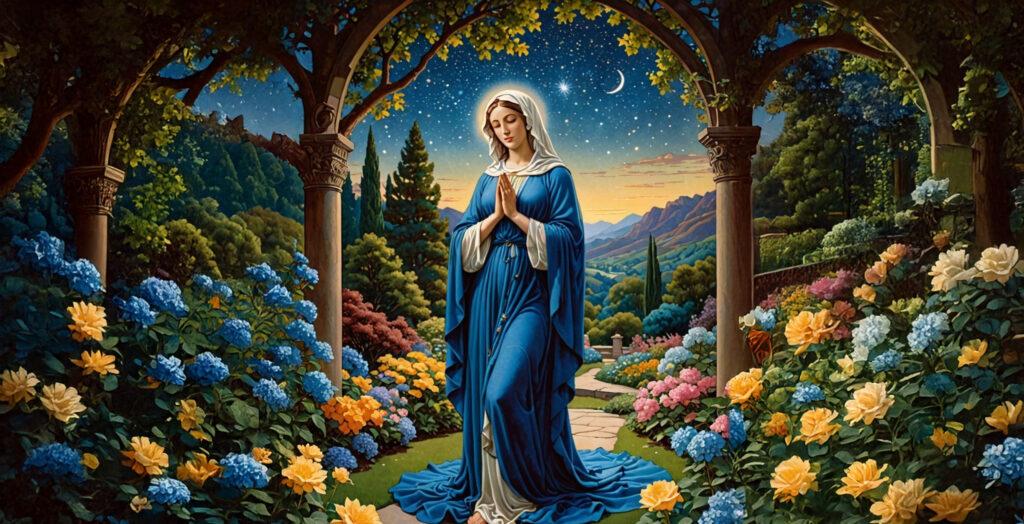
Before Mother Mary, we should first set the scene with the story of Gabriel, which begins in the Gospel of Luke, where he was sent as a divine messenger to Mary, a young woman in Nazareth. Gabriel greets her, saying, “Greetings, you who are highly favored! The Lord is with you.” Understandably, Mary is confused and frightened by this sudden appearance, but Gabriel reassures her, “Do not be afraid, Mary; you have found favor with God.”
He tells her she will conceive and give birth to a son named Jesus. “He will be great and will be called the Son of the Most High. The Lord God will give him the throne of his father David, and he will reign over Jacob’s descendants forever; his kingdom will never end.”
Mary, astonished, asks, “How will this be, since I am a virgin?” Gabriel explains that the Holy Spirit will come upon her, and the power of the Most High will overshadow her, making her child holy and divine. He further reveals that her relative Elizabeth, who was barren, is also pregnant as a sign of God’s power, for “no word from God will ever fail.”
Mary accepts her role with humility, saying, “I am the Lord’s servant. May your word to me be fulfilled.” With that, Gabriel departs, having delivered his life-changing message.
But what if Mary and Jesus’ Story Was Galactic in Nature?
What if Gabriel wasn’t simply an angel in the traditional sense but a highly advanced being, a messenger from an interstellar civilization tasked with guiding humanity? What if his task wasn’t just about announcing a divine birth but initiating a cosmic mission to elevate Earth’s consciousness?
Gabriel’s visit, then, becomes more than a divine encounter. Picture Mary, sitting quietly, when a luminous figure materializes before her—a being radiating intelligence and peace, communicating telepathically or in a language so advanced it feels like pure understanding. His message is the same: she will bear a child, but this time, it’s framed as part of a greater cosmic mission. The child, Jesus, would carry within him the codes for awakening humanity—teaching love, expanding consciousness, and the realization of humanity’s connection to a vast, interconnected universe.
The “immaculate conception”, perhaps an advanced energetic process, bypassing traditional human reproduction. Gabriel’s explanation about the Holy Spirit overshadowing her might then symbolize a merging of Earthly and cosmic energies, creating a being who is both human and universal in nature.
Now consider Jesus in this context. His teachings—love your neighbor, forgive endlessly, seek higher truths—could reflect universal principles meant to guide humanity out of its lower vibrational state. His miracles, such as healing the sick and calming the storm, might not just be divine acts but expressions of mastery over universal laws of energy and matter.
Mary’s role, then, takes on even greater significance. She becomes not only the mother of Jesus but a sacred ethereal conduit between Earth and the distant stars, nurturing a being who carries the potential to unite humanity with a greater galactic establishment. And Gabriel? His presence might underscore the connection between Earth and a vast cosmic intelligence, one that has watched over and guided humanity since its earliest days.
In this reimagining, the story of Mary and Jesus becomes not just a tale of faith and divinity but a notion that humanity may be part of something far greater—a universal story of awakening, evolution, and our divine connection to our lost cosmic origins.