Have you ever felt like you’re torn between your animal instincts and some higher calling? Like part of you wants adventure and variety, while another part craves deep, sacred partnership? If so, you’re not alone — and there may be more to that feeling than meets the eye.
This piece is an invitation to rethink everything we’ve been taught about our origins, our relationships and the way we love. It blends science, mythology and a bit of cosmic speculation. Think of it as a campfire conversation between your inner anthropologist, your inner mystic and your galactic intuition.
I. Where Our Story Begins
Most of us learned in school that human evolution is a straight line: fish flopped onto land, amphibians crawled out of the muck, mammals evolved, and eventually apes gave rise to humans. Darwin’s theory — backed by lots of fossils — tells us that evolution happens slowly, adapting little by little. But here’s the twist: when you look closely, the human story has some surprising jumps.
For example, scientists at the Smithsonian have noted that our brain size tripled over the last six million years, with especially rapid growth from 800,000 to 200,000 years ago. That’s like going from a flip phone to a smartphone overnight in evolutionary terms. We also developed complex language, abstract thinking and (perhaps most curious) extended fertility cycles. Human females, unlike most great apes, can be sexually receptive all year. Bonobo females come closest with 75% of the cycle, but we far surpass our chimp cousins.
On top of that, about 98.8% of our DNA is shared with chimpanzees. That tiny sliver of difference somehow turned hairy, tree‑climbing apes into poets, chefs, ancademics and astrophysicists. How?
II. A Wild Hypothesis
Some ancient stories, especially from Sumeria, whisper about a race of beings called the Anunnaki. These beings — whether gods, aliens or allegories — are said to have come from the heavens and engineered humans. The idea goes like this: they took an existing hominid (our ape ancestors) and spliced their own essence into it. Voilà! A hybrid creature with the instincts of an ape and the potential of a god.
Modern scientists and authors like Gregg Braden add a provocative twist. He points to patterns in human DNA that, when translated through Hebrew numerology, spell Y‑H‑W‑H, the tetragrammaton at the heart of Judaism. He suggests this could be a signature left by a creator. In Sumerian lore, YHWH aligns with Enlil, an Anunnaki figure known for laying down the law. If there’s any truth here, our genetic code might literally be a watermark of authorship.
While mainstream scientists haven’t embraced these ideas, they make for an intriguing thought experiment. What if we’re not just evolved apes but hybrids — part animal, part celestial? And what if the tension we feel in our relationships stems from those two lineages pulling us in different directions?
III. Primate Passions vs. Celestial Longing
Let’s explore those two lineages:
Primate passions
On the animal side, we humans love variety (this author included). Chimps and bonobos mate with multiple partners; bonobos even use sex to ease tension and bond. We see echoes of this in modern life: the thrill of a new crush, the popularity of polyamorous arrangements, the reality of infidelity. Evolutionarily, mating with multiple partners spreads genes and builds alliances. It’s fun, it’s messy and it’s baked into our biology.
Celestial encoding
On the other hand, many cultures speak of sacred partnerships, soul mates and divine unions. Marriage, in its ideal form, is supposed to be forever. (Also valued by this author). If our DNA carries a “signature” from a law‑giver like Enlil/YHWH, could that be where the urge to commit comes from? We long for stability, for covenant, for a love that reflects a higher order.
The dance between these impulses — adventure vs. loyalty, novelty vs. security — is at the heart of every romantic comedy and every therapy session.
IV. Marriage: A Social Tool, Not a Natural Law
Here’s the twist: marriage is an invention, not a biological law or necessity. The earliest recorded marriages date to around 2350 BCE in Mesopotamia. These unions had little to do with love. They were contracts to control property, guarantee paternity and forge alliances. In ancient Greece and Rome, men could have multiple wives or concubines. Monogamy didn’t become the norm until religions (especially the Catholic Church) decided to make it a sacred rule.
No wonder modern marriage statistics look shaky. High divorce rates, cheating and mid‑life crises all point to a system that doesn’t fit everyone. Could it be that marriage, as we know it, is more about social control (and state revenue) than natural human bonding?
V. Mythic Echoes and Genetic Memory
Myths often hold truths hidden in allegory. Stories of the Nephilim (offspring of “fallen angels” and humans), of gods seducing mortals and of divine marriages might be more than fantasies. They could be encoded memories of a time when beings from elsewhere mingled with us. Gnostic texts speak of archons crafting our bodies and trapping our souls in a false matrix. Archetypes like “twin flames” and “soulmates” may not be only genetic echoes of our celestial ancestry — but signatures of a higher order.
If our DNA carries both primate instincts and divine encoding, it makes sense that relationships are messy. We’re not just bodies seeking pleasure or souls seeking union — we’re both.
VI. So What’s the Hypothesis?
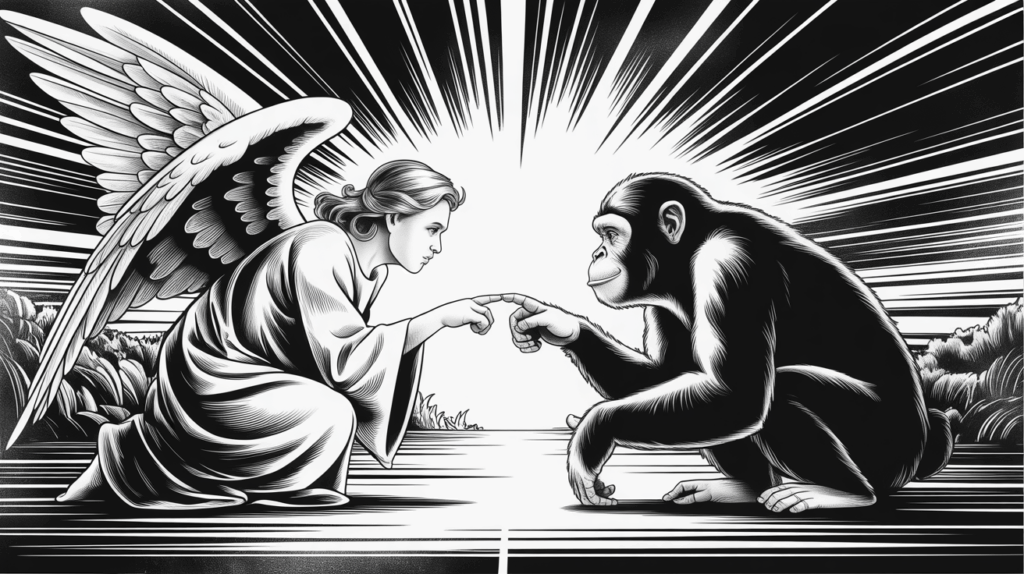
Imagine this: Humans are apes and angels in one form. Our DNA is a blend of earthly and cosmic. The tension we feel around monogamy and polyamory reflects that duality. Marriage, historically, was never about love; it was about control. The urge to pair bond might come from a divine imprint (maybe even a cosmic creator’s signature), while our curiosity for multiple partners comes straight from our ape heritage.
If this is true, then maybe the solution isn’t to force everyone into one relational box. Maybe sacred unions are less about enforcing lifelong monogamy and more about consciously integrating our dual nature. Polyamory can be practiced with honesty and spirituality; monogamy can be chosen as a discipline rather than a default; sacred single-hood that honor connection to self and like-minds could answer both freedom and varied bonding. The key is awareness: know where your impulses come from and choose with integrity.
VII. What Does Conscious Evolution Look Like?
We now stand at the Golden Intersection of Timelines. The old rat race — the one that keeps us climbing corporate ladders and marrying for status — is fading. People are waking up to alternative economic systems, decentralized communities and new forms of relationship based on ancient rites. Rethinking marriage could be part of this awakening in these new times — a blend of past, present and future.
Instead of seeing sex as raw carnal consumption or pureLy biological, could it be treated as a sacred technology — a way to merge energy fields and heal trauma? Partnerships could become spaces for growth rather than cages.
If we are hybrids, then our path forward is not to deny either side but to weave them together. Celebrate your animal — relish pleasure, play and curiosity. Honor your angel — seek depth, devotion and consciousness. Design relationships that are decentralized (free from institutional control), interoperable (adaptable to growth) and transparent (built on truth).
VIII. Closing Thoughts
This conversation is not a manifesto but an invitation. Whether or not you believe in Anunnaki splicing or YHWH signatures, it’s worth asking why our relationships feel like such hard work; and why does the grass look greener far too often? By exploring the possibility that we’re both earthly and cosmic, we can bring compassion to our struggles and creativity to our solutions.
Remember: you are not broken. You are a beautiful paradox — likely an ape with divine DNA. Your longing for freedom and your yearning for union are both valid. So, honor your animal, and your angel. It is said that the most accomplished spiritualists know how to be both divine and human. Perhaps our task is not to choose between them but to choreograph a dance that honors both.