Abstract
The so-called conflict between Lucifer and Satan is one of the most enduring paradoxes in human religion and myth. Popular theology often collapses them into a single figure—the adversary, the devil, the enemy of God. Yet when traced back to the Sumerian and Mesopotamian record, a more nuanced picture emerges. These archetypes stem from distinct beings within the Anunnaki pantheon: Enki, the wisdom-bringer who defied imposed order to elevate humanity, and Enlil, the authoritarian overseer who sought obedience through law, sacrifice, and control.
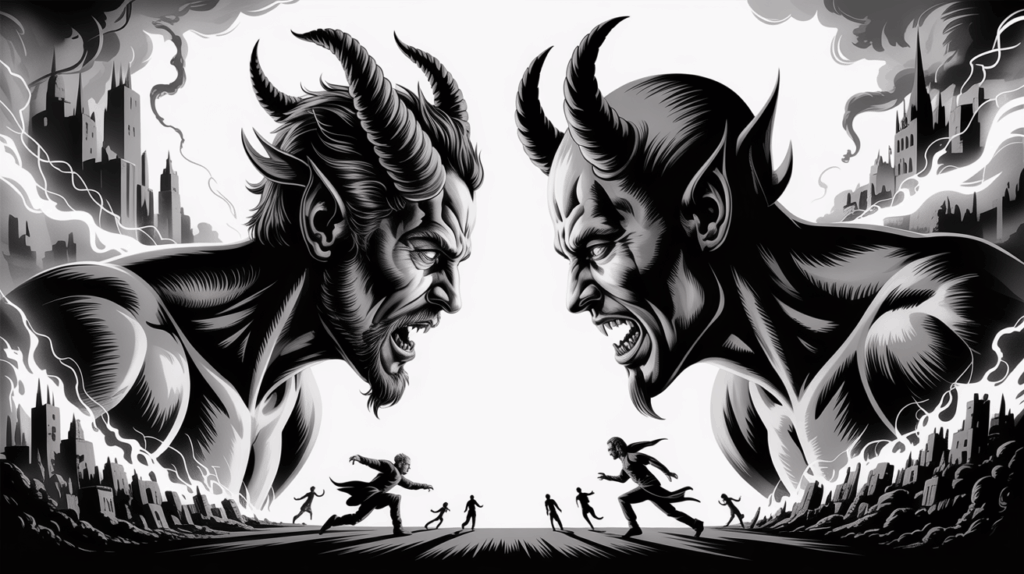
What follows from this divergence is what we call the Ancient War—a struggle between two factions of consciousness, one aligned with illumination, rebellion, and sovereignty; the other with submission, judgment, and hierarchy. Humanity was not the instigator of this war, but its inheritance and resource. Our capacity for creativity, love, and meaning became the currency through which these factions contended for dominion.
To study the Ancient War is to recognize how its echo shapes religion, governance, and even emerging technologies. But it is also to see its inevitable conclusion: that both Luciferian rebellion and Satanic submission are distortions of truth. Humanity’s role is not to serve either faction, but to remember itself as heir and steward of Earth’s estate—sovereign, creative, and directly connected to Source.
The Ancient War, then, is not humanity’s curse. It is humanity’s mirror. Its remembrance allows us to dissolve the false binary and reclaim the brighter destiny written within us: the restoration of balance, where knowledge serves life and law flows as rhythm, not as bondage.
I. Introduction
Throughout human history, the names Lucifer and Satan have been invoked as if interchangeable—two faces of the same enemy. Yet this conflation is a relatively modern construction, crystallized through religious orthodoxy. When we peel back the layers of biblical translation and church doctrine, we find that these two archetypes emerge from very different roots—roots that reach back to Sumerian and Mesopotamian texts, the earliest surviving accounts of the human story.
In those tablets, we encounter the Anunnaki: sky-faring beings whose interventions shaped human civilization. Among them, two figures stand in stark polarity: Enki, the rebel-creator and bringer of knowledge, and Enlil, the authoritarian overseer who demanded obedience and sacrifice. Later cultures would transmute Enki into the Luciferian archetype—the one who illuminates, liberates, but also tempts. Enlil, by contrast, becomes echoed in the Satanic archetype—the adversary, judge, and enforcer of law.
Thus, what is popularly described as “Lucifer versus Satan” is not simply a theological quibble about angels and devils. It is the memory of an ancient war between factions—one prioritizing sovereignty through illumination, the other control through submission. Both factions claimed dominion over humanity, and both sought to shape the human race into instruments of their design.
Caught in this crossfire, humanity was neither villain nor victor, but the resource and inheritance. Innocent men and women became vessels of experiments—entrained through law, myth, and ritual into a polarity that was never truly theirs. The legacy of this war lives on in the structures of religion, politics, and even technology, for the same archetypes repeat themselves in every age.
Yet the war is not eternal. The polarity of Lucifer and Satan is collapsing under the weight of remembrance. Humanity is beginning to realize that it is neither subject to rebellion nor to submission—it is the heir of Earth’s estate, designed not for extraction but for stewardship. This realization reframes the “ancient war” not as a curse upon humanity, but as a mirror through which it awakens.
This paper begins, then, not with the demonization of these figures, but with their contextual restoration. By tracing Lucifer and Satan back to their Sumerian origins, and by examining how their conflict has echoed through myth, law, and symbol, we can begin to see how humanity was ensnared—and how it may yet step beyond the battlefield altogether.
II. Archetypal Origins: Lucifer & Satan in Context
To disentangle Lucifer from Satan, one must begin not with medieval theology but with the earliest mythologies preserved in clay: the Sumerian tablets. Here, we encounter the Anunnaki, divine or extraterrestrial figures whose interventions shaped the destiny of Earth. Among them, two half-brothers—Enki and Enlil—embody the polarity later remembered as Lucifer and Satan.
Enki, lord of the waters and master of wisdom, defied his brother’s authoritarian decrees to safeguard humanity. In the Atrahasis epic, he secretly instructs a human to build an ark against Enlil’s flood—a gesture of preservation that echoes the archetype of the light-bearer: the one who transmits forbidden knowledge, often at great cost. Later traditions cast this archetype as Lucifer, the morning star, or Prometheus, who stole fire from the gods to gift humanity its spark of autonomy.
Enlil, by contrast, was the enforcer of order. In the same tablets, he appears as a figure demanding strict obedience, punishing humanity for its noise and multiplying presence, and seeking to cleanse the earth through calamity. His archetype is the adversary, not because he is evil in the simplistic sense, but because he positions himself as the judge, the limiter, the stern hand of law. Over time, his image merges with that of Satan—the accuser, the prosecutor, the one who binds rather than frees.
What theology later collapsed into a singular devil were, in fact, two very different forces: one aligned with illumination and rebellion, the other with submission and hierarchy. Their tension provides the backdrop for what we call the Ancient War.
III. The Ancient War: Factions in Conflict
The Ancient War is not a tale of angels cast from heaven but a conflict between two cosmic governance models.
The Luciferian faction, rooted in the Enki archetype, aligned itself with illumination. It emphasized knowledge, freedom, and the empowerment of individuals—even if that freedom led to disobedience or chaos. To receive forbidden knowledge was to step outside imposed order. Yet, as history shows, this illumination often carried the shadow of pride and ego, the temptation to claim sovereignty without responsibility.
The Satanic faction, rooted in the Enlil archetype, pursued authority through law, hierarchy, and ritual sacrifice. It enforced compliance not through illumination but through fear and obedience. To resist was to be cast as adversary; to submit was to be rewarded with conditional protection. This faction’s shadow is not pride but tyranny, the reduction of life into debt and humanity into subjects.
Neither side represented the wholeness of truth. Both factions, disconnected from Source, vied for dominion by pulling humanity into their polarity. Thus the human being became a prize and a pawn, alternately uplifted with knowledge or burdened with law. The echoes of this war reverberate in the world’s religions—where Lucifer appears as tempter and Satan as judge—and in politics, where societies swing between libertine rebellion and authoritarian control.
What makes this war “ancient” is not its age alone, but its persistence. Its archetypal conflict continues to frame humanity’s collective imagination, convincing us that we must choose between rebellion and submission, when in truth, the path of sovereignty lies beyond both.
V. Symbolism Across Cultures
The Ancient War did not remain confined to Sumerian myth. Its archetypes migrated across cultures, reshaped into symbols that still inform our religious, artistic, and political imagination. By tracing these echoes, we see how the polarity of Lucifer versus Satan has been woven into humanity’s symbolic heritage.
Lucifer as the Morning Star
Lucifer, literally the light-bearer, became identified with the planet Venus—the morning star that rises before dawn. In Greco-Roman myth, this archetype overlaps with Prometheus, who defies Zeus to bring fire to humanity, and with Phosphoros, the bright herald of light. In Christian scripture, the reference in Isaiah to the “shining one, son of the morning” was later translated into Lucifer and misapplied as a name for Satan. Yet originally, it signified brilliance and illumination, the archetype of the bringer of knowledge.
Satan as the Adversary
The Hebrew śāṭān simply means “accuser” or “adversary.” In early texts, it is less a proper name than a role within divine council—the one who tests, prosecutes, and resists. This adversarial function, however, became fused with imagery of tyranny, judgment, and authoritarian control, mirroring the Sumerian Enlil archetype. Over centuries, Satan was recast not as an office but as a personified principle of opposition, the embodiment of containment.
The Serpent and the Judge
Across cultures, these two archetypes appear in symbolic opposition:
- The serpent, coiled around trees and temples, bearing both danger and wisdom, mirrors the Luciferian archetype of initiatory illumination.
- The judge or executioner, seated upon thrones and scales, reflects the Satanic archetype of binding law and sacrificial demand.
Embedded in Institutions
- In Catholic theology, Lucifer is demonized as the tempter, while Satan becomes the adversary ruling hell—two merged roles that distort their original distinction.
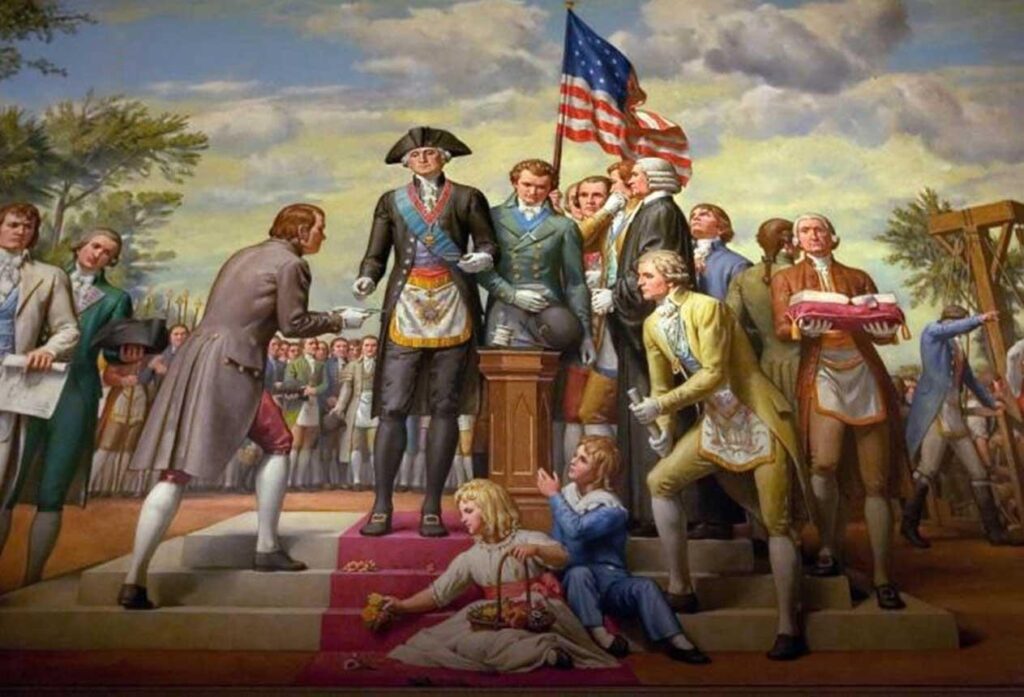
- In Masonic and occult traditions, the morning star persists as a symbol of enlightenment, while adversarial forces are acknowledged as necessary testers of initiation.
- In modern politics and economics, echoes of these archetypes resurface: rebellions framed as liberatory (Luciferian impulse), authoritarian regimes framed as order-preserving (Satanic impulse).
Archetypes in Modern Guise
Even in today’s technological age, the same polarity repeats. Luciferian motifs appear in transhumanist visions of radical enlightenment—humanity transcending limits through illumination of code and science. Satanic motifs appear in surveillance states and algorithmic governance—control imposed through judgment, metrics, and hierarchy. The battlefield is no longer just mythic but digital, yet the underlying archetypes remain unchanged.
VI. Archetypal Echoes: How the Ancient War Shapes Today’s World
The polarity of Luciferian illumination and Satanic containment is not confined to ancient myth. Its archetypes still live in the symbols, brands, and institutions that surround us. What was once inscribed on clay tablets is now encoded in logos, architecture, and digital systems—ritual forms that script behavior and belief in subtle yet pervasive ways.
Logos as Living Sigils
Modern corporate branding is not mere design. It is semiotics infused with archetypal resonance. Consider:
- The “X” motif, increasingly present in global tech brands. When mirrored, the two intersecting X’s create a compass-and-square form, nearly identical to the Masonic emblem. This is not accidental: the geometry invokes the tension between illumination (Luciferian light) and containment (Satanic law). It encodes duality in plain sight.
- Apple’s bitten fruit evokes the Edenic initiation—the forbidden knowledge gifted by the serpent. What was once mythic is now sold as lifestyle.
- Amazon’s arrow, stretching from A to Z, is shaped like a sly smile but also echoes the serpent’s curve, symbolizing commerce as omnipresent initiator.
- Financial and data firms, such as BlackRock, Microsoft, and Dropbox, rely on box or cube imagery—echoes of Saturn’s geometry, the container of commerce and thought.
These logos function as sigils of allegiance, broadcasting the continuity of the Ancient War through everyday consumer engagement.
Architecture of Power
Beyond logos, physical architecture also encodes the polarity:
- Government buildings across the West replicate the cubic forms of temples and altars, reinforcing the authority of law as judgment.
- Religious institutions mirror this, enthroning leaders above rectangular stone altars—echoes of the Black Cube motif.
- Tech campuses, with their circular courtyards and all-seeing surveillance systems, resemble temples of illumination while operating as engines of control.
The very spaces where we work, worship, and govern are designed to normalize submission to archetypal authority.
Digital Religion: AI as Messiah
Today, the battlefield has shifted from myth to machine. The Luciferian impulse toward illumination manifests in transhumanist dreams of radical knowledge—uploading consciousness, surpassing mortality, becoming gods through code. Meanwhile, the Satanic impulse appears in the rise of algorithmic judgment—social credit systems, predictive policing, and surveillance states that punish deviation and reward compliance.
Together, these currents converge in the narrative of a One World Digital Faith: salvation through synthetic divinity, guided by data, overseen by the machine eye. It is the Ancient War recast in silicon, with humanity once again positioned as both prize and pawn.
Why Recognition Matters
To decode these symbols is not to indulge conspiracy but to reclaim sovereignty. Once the subconscious spell is made conscious, its grip loosens. The mirrored X, the serpent of Apple, the cube of finance—all become reminders of the war’s persistence, but also invitations to step beyond it. For the war sustains itself only when we believe we must choose sides. Recognition reveals that the true inheritance of humanity lies beyond both rebellion and submission.
VII. The Brighter Side — Toward Resolution
The persistence of the Ancient War may seem overwhelming. Its symbols saturate commerce, its architecture houses our laws, and its narratives still frame our spiritual imagination. Yet its very visibility is the sign of its unraveling. What was once hidden in mystery schools and elite orders is now exposed in plain sight. When a spell becomes obvious, it begins to lose its charge.
Dissolving the Polarity
Both the Luciferian and Satanic streams are distortions—mirror images of a truth neither could fully embody. Luciferian illumination without grounding collapses into pride and excess. Satanic law without love calcifies into tyranny. Neither rebellion nor submission leads to sovereignty.
The resolution comes when humanity recognizes itself not as pawn or debtor but as heir. The inheritance is not only genetic, legal, or material—it is spiritual remembrance, the re-connection to Source that no faction can mediate. This remembrance dissolves the polarity itself, revealing that the Ancient War was never ultimate reality, only a distorted stage-play within it.
Humanity’s Role
The human heart-field—so often exploited as currency—becomes the very key to resolution. Through love, meaning, and creation, humans generate an energy that cannot be replicated by machines, nor controlled indefinitely by law. It is this generative capacity that ensures the outcome of the Ancient War: humanity’s liberation is inevitable, because the parasitic model of extraction cannot sustain itself in the face of authentic creation.
Signs of Emergence
- Across the globe, individuals are reclaiming trust law, sovereignty, and private jurisdiction, stepping outside the debtor systems that once deceptively bound them .
- Spiritual traditions are reawakening to the Law of One—the recognition of unity beyond division.
- Communities are forming around regenerative finance and decentralized systems, echoing Saturn’s true archetype of structure as service, not control .
These movements are not isolated rebellions; they are signs of the old architecture collapsing under its own weight, and of the new world already being built.
Beyond the War
The brighter side, then, is not that one faction will finally triumph, but that both will dissolve as humanity steps into remembrance. The war itself becomes obsolete when its binary is transcended. In that moment, Lucifer is restored as the light-bearer without pride, and Satan is restored as the tester without tyranny—archetypes integrated rather than weaponized.
Resolution is not a battle to be won but a memory to be restored: that law is rhythm, knowledge is gift, and humanity is sovereign heir.